Qu'est-ce que l'Armagnac ? Quelle différence avec le Cognac ? Que signifient VS, VSOP ou XO ? Comment choisir,...

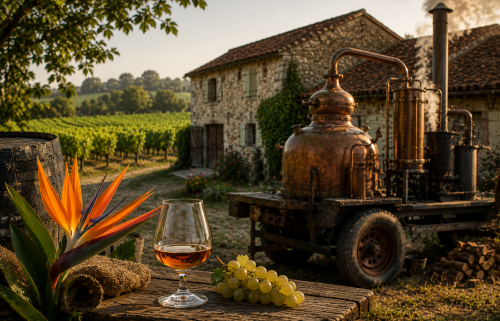
Qu'est-ce que l'Armagnac ? Quelle différence avec le Cognac ? Que signifient VS, VSOP ou XO ? Comment choisir,...
Entretien exclusif avec Alexandre Vingtier. Il fait partie de ces esprits rares capables de penser le spiritueux à...

Entretien exclusif avec Alexandre Vingtier. Il fait partie de ces esprits rares capables de penser le spiritueux à...

Introduction Auteur, critique, consultant et enseignant, Alexandre Vingtier est une figure incontournable du monde...
What if Swiss National Day was also celebrated in the glass? Discover five bold pairings between traditional Swiss...
No featured images
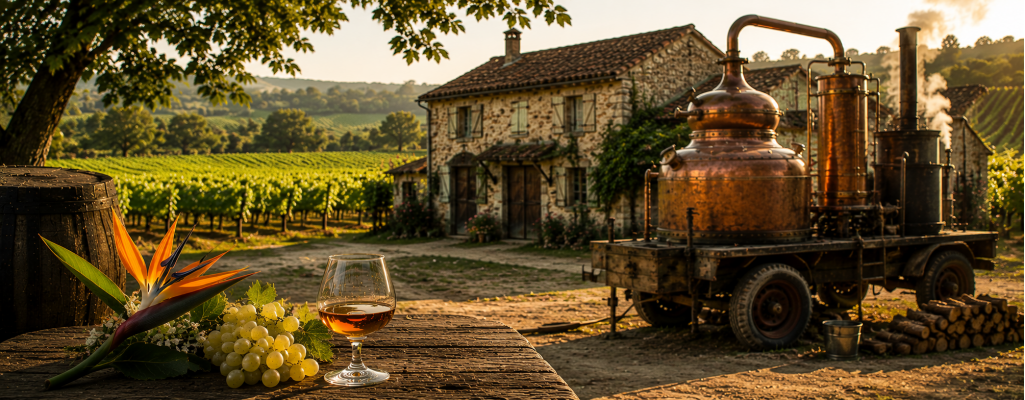
Vous découvrez l'Armagnac ou souhaitez mieux comprendre ce grand spiritueux français ? Vous vous demandez quelle est la différence avec le Cognac, comment il est élaboré ou encore ce que signifient les mentions VS, VSOP ou XO ?
À travers les dix questions les plus fréquemment posées, découvrez l'essentiel pour comprendre l'Armagnac : son origine, sa fabrication, ses terroirs, ses catégories d'âge et les conseils pour bien choisir, déguster et conserver une bouteille.
Temps de lecture : 8 min
L'Armagnac est une eau-de-vie de vin produite exclusivement en Gascogne, dans le sud-ouest de la France. Il est obtenu par la distillation d'un vin blanc, puis élevé en fûts de chêne, où il développe progressivement sa couleur, sa texture et sa richesse aromatique.
Son histoire remonte au début du XIVᵉ siècle. Les premiers écrits connus mentionnant l'Armagnac datent de cette époque, ce qui en fait la plus ancienne eau-de-vie de vin française dont la production s'est poursuivie jusqu'à aujourd'hui. Au fil des siècles, il s'est imposé comme l'un des grands spiritueux français, apprécié pour son authenticité, la diversité de ses styles et son profond attachement à son terroir.
Mais l'Armagnac ne se résume pas à une simple eau-de-vie. Derrière chaque bouteille se trouvent des vignerons, des distillateurs et des maîtres de chai qui perpétuent un savoir-faire transmis de génération en génération. La production est encadrée par une Appellation d'Origine Contrôlée (AOC), dont le cahier des charges définit notamment l'aire géographique, les cépages autorisés, les méthodes de distillation et les conditions de vieillissement.
Cette combinaison entre terroir, tradition et savoir-faire explique pourquoi deux Armagnacs peuvent offrir des profils aromatiques très différents, tout en appartenant à la même appellation.
La première clé pour comprendre cette diversité est de s'intéresser à son territoire de production.
L'Armagnac fait partie de ces spiritueux intimement liés à leur territoire. Contrairement à d'autres eaux-de-vie produites dans plusieurs régions du monde, il ne peut être élaboré que dans une zone géographique bien définie du sud-ouest de la France. Cette origine n'est pas un simple détail : elle est au cœur de son identité.
Depuis 1936, l'Armagnac bénéficie d'une Appellation d'Origine Contrôlée (AOC), aujourd'hui reconnue au niveau européen comme Appellation d'Origine Protégée (AOP). Cela signifie qu'une bouteille ne peut porter le nom « Armagnac » que si elle respecte un cahier des charges précis, qui encadre notamment l'origine des raisins, les cépages autorisés, les méthodes de distillation, le vieillissement et les conditions de production.
L'aire d'appellation couvre environ 15 000 hectares de vignes répartis sur trois départements :
• le Gers, qui concentre l'essentiel de la production ;
• les Landes ;
• le Lot-et-Garonne.
À l'intérieur de cette aire se distinguent trois grands terroirs, chacun possédant des caractéristiques géologiques et des expressions aromatiques qui lui sont propres.
Le Bas-Armagnac
Malgré son nom, le Bas-Armagnac ne se situe pas au sud de l'appellation, mais à l'ouest. C'est le terroir le plus vaste et le plus réputé.
Ses célèbres sables fauves, riches en silice et pauvres en argile, donnent généralement naissance à des eaux-de-vie fines et élégantes, reconnues pour leur excellent potentiel de vieillissement.
De nombreux domaines historiques de l'appellation y sont installés, ce qui contribue largement à la notoriété de ce terroir.
La Ténarèze
Au centre de l'appellation s'étend la Ténarèze.
Ses sols, plus argilo-calcaires, produisent souvent des eaux-de-vie offrant davantage de structure dans leur jeunesse. Avec le temps, elles développent une belle complexité aromatique et une grande profondeur, ce qui en fait des Armagnacs particulièrement intéressants pour les vieillissements prolongés.
Le Haut-Armagnac
Le Haut-Armagnac occupe la partie orientale de l'appellation.
Aujourd'hui, ce terroir représente une faible part de la production totale. Les vignobles y sont plus dispersés et les Armagnacs qui en sont issus restent relativement rares.
Moins connu que le Bas-Armagnac ou la Ténarèze, il participe néanmoins pleinement à la diversité de l'appellation et témoigne de la richesse des paysages viticoles gascons.
Le terroir n'explique pas tout
Il est tentant d'associer chaque terroir à un style bien défini. La réalité est toutefois plus nuancée.
Le sol influence naturellement le caractère d'un Armagnac, mais il n'agit jamais seul. Les cépages, le type de distillation, le choix des fûts, la durée du vieillissement et le savoir-faire du producteur contribuent eux aussi à façonner le profil aromatique d'une eau-de-vie.
Autrement dit, deux Armagnacs issus d'un même terroir peuvent offrir des expressions très différentes.
C'est précisément cette diversité qui fait tout l'intérêt de l'Armagnac et qui invite les amateurs à découvrir les domaines, les millésimes et les styles propres à chaque producteur.
Le Cognac et l'Armagnac sont souvent comparés, et pour cause : tous deux sont des eaux-de-vie de vin françaises élaborées à partir de raisins blancs, distillées puis vieillies en fûts de chêne. Pourtant, derrière ces points communs se cachent deux appellations bien distinctes, chacune avec son histoire, son terroir et son identité.
La première différence est d'ordre géographique. Le Cognac est produit en Charente et en Charente-Maritime, tandis que l'Armagnac est élaboré en Gascogne, principalement dans le Gers, les Landes et le Lot-et-Garonne. Comme pour le vin, cette origine influence naturellement le style des eaux-de-vie.
La distillation constitue une autre différence majeure. Le Cognac est généralement obtenu par une double distillation dans un alambic charentais, aussi appelé alambic à repasse. L'Armagnac, lui, est le plus souvent distillé une seule fois dans un alambic armagnacais à distillation continue.
Cette méthode permet d'obtenir une eau-de-vie à un degré alcoolique plus faible à la sortie de l'alambic, tout en préservant une grande richesse aromatique. Quelques producteurs choisissent toutefois la double distillation, mais cette pratique reste minoritaire en Armagnac.
Les cépages constituent également une différence importante. Si l'Ugni Blanc est largement majoritaire dans les deux appellations, l'Armagnac utilise plus fréquemment le Baco Blanc, un cépage emblématique de la région, quasiment absent en Cognac.
Autre particularité : les millésimes. En Armagnac, il est courant de trouver des bouteilles issues d'une seule année de récolte, comme un millésime 1985 ou 2003. Cette tradition est profondément ancrée dans l'appellation. Le Cognac est, quant à lui, principalement commercialisé sous forme d'assemblages, même si quelques millésimes existent dans des cas particuliers.
Ces différences influencent le style des eaux-de-vie, mais il serait réducteur d'en tirer des conclusions définitives. On entend parfois que le Cognac serait systématiquement plus doux ou plus élégant, tandis que l'Armagnac serait toujours plus puissant ou plus rustique. En réalité, les profils varient énormément selon le terroir, le producteur, les cépages, la distillation et le vieillissement.
D'une manière générale, les amateurs décrivent souvent le Cognac comme davantage tourné vers la régularité des assemblages, tandis que l'Armagnac exprime plus volontiers le caractère d'un terroir, d'un domaine ou d'un millésime. Il s'agit toutefois de tendances, et non de règles absolues.
Le meilleur moyen de comprendre leurs différences reste encore de les déguster côte à côte. C'est souvent à ce moment-là que chacun révèle pleinement sa personnalité.
Armagnac Cognac
Produit en Gascogne Produit en Charente et en Charente-Maritime
Distillation généralement continue Double distillation majoritaire
Utilisation fréquente du Baco Blanc Ugni Blanc très largement majoritaire
Millésimes courants Assemblages largement majoritaires
Grande diversité d'expressions selon les terroirs, les domaines et les millésimes Recherche d'un style fidèle à la maison grâce à l'assemblage
Lequel choisir ?
Il n'existe pas de réponse universelle.
Si vous aimez découvrir l'influence d'un terroir, d'un producteur ou d'une année de récolte, l'Armagnac offre une diversité remarquable, notamment grâce à ses nombreux millésimes.
Si vous recherchez des assemblages emblématiques issus de grandes maisons, avec un style relativement constant d'une bouteille à l'autre, le Cognac constitue également une excellente porte d'entrée dans l'univers des eaux-de-vie de vin.
Plutôt que de les opposer, il est préférable de les considérer comme deux grandes traditions françaises, chacune exprimant sa propre identité.
Avant d'arriver dans votre verre, un Armagnac passe par plusieurs étapes essentielles. De la récolte des raisins jusqu'à la mise en bouteille, chaque décision influence le caractère de l'eau-de-vie. Certaines cuvées passeront seulement quelques années en fût, tandis que d'autres y vieilliront pendant plusieurs décennies.
De la vigne au vin
Tout commence avec les vendanges, généralement entre septembre et octobre. Les raisins sont rapidement pressés afin d'obtenir un jus qui entre ensuite en fermentation.
Sous l'action des levures, les sucres naturellement présents dans le raisin se transforment en alcool. On obtient alors un vin blanc sec, destiné non pas à être dégusté, mais à être distillé.
Ce vin présente généralement un degré d'alcool compris entre 8 et 10 % vol. ainsi qu'une belle acidité, deux caractéristiques recherchées pour produire une eau-de-vie équilibrée.
La distillation : naissance de l'eau-de-vie
Une fois la fermentation terminée, le vin est distillé pendant la campagne de distillation, qui s'étend traditionnellement de la fin des vendanges jusqu'au 31 mars suivant la récolte.
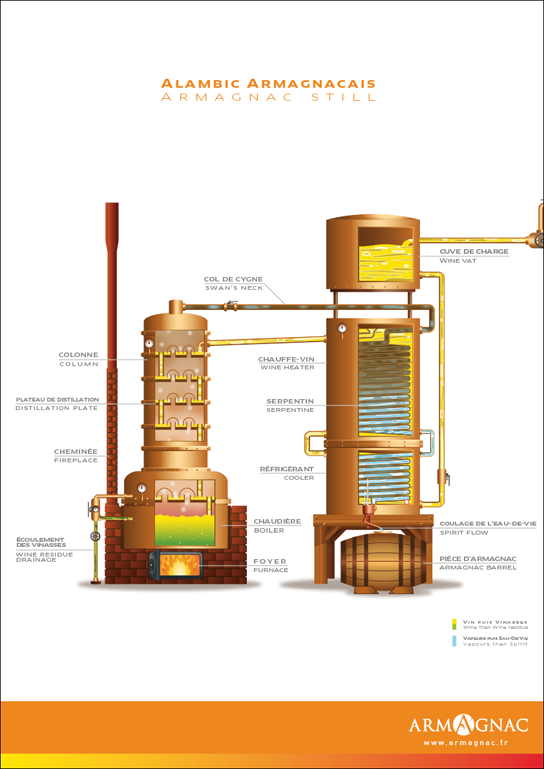
La grande majorité des producteurs utilisent un alambic armagnacais, un appareil en cuivre fonctionnant selon le principe de la distillation continue. Contrairement au Cognac, qui est généralement obtenu par double distillation, le vin ne traverse ici l'alambic qu'une seule fois.
À la sortie de l'alambic, l'eau-de-vie est totalement limpide. Elle titre généralement entre 52 % et 72,4 % vol., conformément au cahier des charges de l'appellation, et possède déjà une grande richesse aromatique.
Le vieillissement en fûts de chêne
La distillation ne marque pourtant que le début de l'histoire.
L'eau-de-vie est ensuite transférée dans des fûts de chêne où elle va lentement évoluer. Au fil des années, elle se colore naturellement et développe des arômes de vanille, d'épices, de fruits secs, de cacao ou encore de bois précieux, selon les fûts utilisés et la durée du vieillissement.
Une petite partie de l'alcool et de l'eau s'évapore progressivement à travers le bois. Ce phénomène naturel est connu sous le nom de part des anges.
Le rôle du maître de chai
Pendant tout le vieillissement, rien n'est laissé au hasard.
Le maître de chai suit l'évolution de chaque eau-de-vie, contrôle les fûts et décide du moment où elle a atteint son équilibre. C'est également lui qui choisit, selon le style recherché, de réaliser un assemblage de plusieurs eaux-de-vie ou de conserver un millésime issu d'une seule année de récolte.
Lorsque le vieillissement est jugé suffisant, l'Armagnac est préparé pour la mise en bouteille. À partir de ce moment-là, son évolution en fût s'arrête définitivement.
Cette dernière étape est importante, car elle permet de comprendre une idée souvent reçue : une bouteille d'Armagnac ne continue plus à vieillir une fois bouchée.
Comme pour le vin, tout commence par le raisin. Le choix des cépages joue un rôle essentiel dans le caractère d'un Armagnac, même si leur influence est ensuite façonnée par la distillation et le vieillissement.
Le cahier des charges de l'appellation autorise plusieurs cépages, mais quatre d'entre eux constituent aujourd'hui l'immense majorité du vignoble : l'Ugni Blanc, le Baco Blanc, la Folle Blanche et le Colombard. Chacun apporte ses propres qualités et participe, seul ou en assemblage, à l'équilibre des eaux-de-vie.
L'Ugni Blanc : le pilier de l'appellation
Très largement majoritaire, l'Ugni Blanc est aujourd'hui le cépage le plus cultivé en Armagnac.
Il produit des vins peu alcoolisés et naturellement acides, des caractéristiques idéales pour la distillation. Les eaux-de-vie qui en sont issues offrent généralement une belle finesse et constituent une excellente base pour les vieillissements prolongés.
Le Baco Blanc : une signature de l'Armagnac
Le Baco Blanc occupe une place à part.
Créé à la fin du XIXᵉ siècle pour faire face aux conséquences du phylloxéra, il est aujourd'hui devenu l'un des cépages emblématiques de l'Armagnac. Contrairement au Cognac, où il est quasiment absent, il est pleinement intégré à l'identité de l'appellation.
Il apporte souvent de la structure, de la rondeur et une belle richesse aromatique, particulièrement appréciées après plusieurs années de vieillissement.
La Folle Blanche : finesse et élégance
Avant la crise du phylloxéra, la Folle Blanche dominait largement le vignoble gascon.
Plus fragile et plus sensible aux maladies, elle est aujourd'hui moins cultivée, mais reste très recherchée par certains producteurs. Elle donne des eaux-de-vie réputées pour leur fraîcheur, leur finesse et leur élégance aromatique, notamment dans leur jeunesse.
Le Colombard : fraîcheur et intensité aromatique
Le Colombard est utilisé en plus faible proportion, mais il apporte une personnalité bien marquée aux assemblages.
Il est apprécié pour son intensité aromatique, sa vivacité et ses notes fruitées, qui contribuent à l'équilibre de certaines eaux-de-vie.
L'assemblage, un véritable savoir-faire
Il est rare qu'un Armagnac repose sur un seul cépage. La plupart des producteurs assemblent plusieurs variétés afin de rechercher le meilleur équilibre entre fraîcheur, structure, complexité et potentiel de vieillissement.
Le cépage constitue donc une pièce importante du puzzle, mais il n'explique jamais, à lui seul, le style d'un Armagnac. Le terroir, la distillation, le choix des fûts et le temps passé en cave jouent eux aussi un rôle déterminant
Lorsque vous observez une bouteille d'Armagnac, vous remarquerez souvent des mentions comme VS, VSOP, XO ou Hors d'Âge. Elles ne décrivent ni un niveau de qualité, ni une dégustation, mais indiquent l'âge minimal de l'eau-de-vie la plus jeune entrant dans l'assemblage.
Autrement dit, si une bouteille porte la mention VSOP, cela signifie que toutes les eaux-de-vie qui la composent ont vieilli au moins quatre ans en fût de chêne. Rien n'empêche en revanche le producteur d'utiliser des eaux-de-vie beaucoup plus anciennes.
VS (Very Special)
La mention VS correspond à un vieillissement minimum de 1 an en fût de chêne.
Ces Armagnacs mettent souvent en avant la fraîcheur du fruit et les arômes issus de la distillation. Ils sont parfois utilisés en cocktail, mais peuvent également être dégustés purs.
VSOP (Very Superior Old Pale)
La mention VSOP garantit un vieillissement minimum de 4 ans.
Avec le temps, l'eau-de-vie gagne en rondeur et en complexité. Les notes boisées commencent à s'intégrer harmonieusement aux arômes de fruits, d'épices et de vanille.
XO et Hors d'Âge
Les mentions XO et Hors d'Âge correspondent toutes deux à un vieillissement minimum de 10 ans pour l'eau-de-vie la plus jeune de l'assemblage.
En pratique, de nombreux producteurs vont bien au-delà de cette durée minimale. Il n'est pas rare de rencontrer des XO ayant passé quinze, vingt ans ou davantage en fût.
Avec le temps, les arômes évoluent vers des notes plus profondes de fruits secs, de cacao, de tabac, de cuir, de rancio ou encore de bois précieux.
Et la mention « Napoléon » ?
La mention Napoléon existe également, même si elle est aujourd'hui moins fréquente.
Lorsqu'elle est utilisée, elle correspond à un vieillissement minimum de 6 ans. Certaines maisons continuent de l'employer par tradition, mais les mentions VSOP, XO et Hors d'Âge sont désormais les plus répandues.
Les principales mentions d'âge
Mention Vieillissement minimum de la plus jeune eau-de-vie
Blanche Armagnac Pas de vieillissement sous bois
VS ou *** 1 an
VSOP, VO ou Réserve 4 ans
XO 10 ans
Hors d'Âge Au moins 10 ans (souvent davantage)
À retenir
Les mentions d'âge constituent un excellent point de repère, mais elles ne permettent pas, à elles seules, de juger la qualité d'un Armagnac.
Deux XO peuvent offrir des profils totalement différents selon les cépages, le terroir, le type de distillation, les fûts utilisés ou encore les choix du producteur. Ces indications renseignent avant tout sur la durée minimale du vieillissement, pas sur le style ou la valeur d'une bouteille.
L'une des particularités de l'Armagnac est la place importante qu'occupent les millésimes. Contrairement à de nombreux autres spiritueux, il est fréquent de trouver des bouteilles portant une année précise, comme 1985, 1997 ou 2003, tandis que d'autres affichent simplement une mention telle que VSOP ou XO. Ces deux indications correspondent pourtant à des approches très différentes de l'élaboration de l'Armagnac.
L'Armagnac millésimé
Un Armagnac millésimé provient d'une seule année de récolte.
Les raisins sont vendangés la même année, puis l'eau-de-vie est distillée, élevée en fût et conservée séparément jusqu'à sa mise en bouteille. Chaque millésime exprime ainsi les caractéristiques d'une récolte précise, influencée par le climat, le terroir et les conditions de l'année.
C'est l'une des grandes richesses de l'Armagnac. Contrairement au Cognac, où les millésimes restent exceptionnels, ils occupent une place importante dans la tradition armagnacaise.
Pour de nombreux amateurs, un millésime possède également une dimension personnelle : il peut correspondre à une année de naissance, un mariage, un anniversaire ou un autre événement marquant.
L'assemblage
À l'inverse, un assemblage réunit plusieurs eaux-de-vie d'âges, de cépages ou parfois de terroirs différents.
L'objectif n'est pas de mettre en avant une année particulière, mais de rechercher un équilibre aromatique. Le maître de chai sélectionne les différentes eaux-de-vie afin d'obtenir le style souhaité, en jouant sur leur complémentarité.
Cette pratique demande une grande expérience et constitue un véritable savoir-faire.
Deux philosophies, deux expériences
Ni le millésime ni l'assemblage ne sont supérieurs l'un à l'autre.
Un millésime séduira souvent les amateurs qui souhaitent découvrir le caractère d'une année précise ou offrir une bouteille à forte valeur symbolique.
Un assemblage permettra davantage de rechercher un profil aromatique spécifique, façonné par les choix du producteur et le travail du maître de chai.
Dans les deux cas, la qualité dépend avant tout des raisins, de la distillation, du vieillissement et du savoir-faire du domaine.
À retenir
Le choix entre un millésime et un assemblage est avant tout une question d'envie.
Si vous recherchez une bouteille liée à une année particulière ou l'expression d'une récolte unique, un Armagnac millésimé est souvent le meilleur choix.
Si vous privilégiez l'équilibre, la régularité ou un style propre à un producteur, un assemblage répondra parfaitement à vos attentes.
Armagnac millésimé Armagnac d'assemblage
Une seule année de récolte Plusieurs eaux-de-vie assemblées
Expression d'un millésime précis Recherche d'un équilibre aromatique
Chaque année possède sa propre personnalité Style défini par le maître de chai
Très apprécié pour les cadeaux et anniversaires Représente le style d'une maison ou d'un domaine
Il n'existe pas d'Armagnac idéal pour tout le monde. Le meilleur sera avant tout celui qui correspond à vos goûts, à votre expérience et à l'occasion.
Que vous découvriez l'Armagnac ou que vous recherchiez une bouteille plus rare, quelques repères permettent de s'orienter plus facilement.
Vous débutez ?
Pour une première découverte, un VSOP ou un XO constitue souvent un excellent point de départ.
Le vieillissement a déjà apporté de la rondeur et de la complexité, tout en conservant un bel équilibre entre le fruit, les épices et le bois. Ces catégories permettent généralement d'apprécier le style d'un producteur sans se tourner immédiatement vers des eaux-de-vie très anciennes.
Vous aimez les eaux-de-vie expressives ?
Si vous recherchez davantage de caractère, explorez les Armagnacs millésimés.
Chaque année possède sa propre personnalité, façonnée par le climat, le terroir et les choix du producteur. Deux millésimes issus du même domaine peuvent ainsi offrir des profils aromatiques très différents.
C'est aussi ce qui fait le charme de l'Armagnac : chaque bouteille raconte une histoire différente.
Vous cherchez un cadeau ?
L'Armagnac est l'un des rares grands spiritueux où les millésimes anciens sont relativement faciles à trouver.
Choisir une bouteille correspondant à une année de naissance, un mariage ou un anniversaire est une idée de cadeau particulièrement appréciée des amateurs.
Ne vous fiez pas uniquement à l'âge
On pourrait penser qu'un Armagnac de trente ans sera forcément meilleur qu'un autre de quinze ans. En réalité, ce n'est pas aussi simple.
La qualité dépend de nombreux facteurs : le terroir, les cépages, la distillation, le choix des fûts, les conditions de vieillissement et, surtout, le savoir-faire du producteur.
Un Armagnac plus jeune peut se révéler plus vivant, plus précis ou mieux équilibré qu'une eau-de-vie beaucoup plus âgée.
Le producteur fait souvent la différence
Au-delà des mentions d'âge ou du millésime, le domaine ou la maison joue un rôle essentiel.
Chaque producteur possède sa propre philosophie : choix des cépages, type de distillation, durée du vieillissement, sélection des fûts ou style des assemblages. C'est cette identité qui donne à chaque Armagnac son caractère.
À mesure que vous découvrirez différents producteurs, vous identifierez naturellement les styles qui correspondent le mieux à vos préférences.
À retenir
Le meilleur conseil reste de rester curieux.
Ne choisissez pas une bouteille uniquement pour son âge ou son millésime. Intéressez-vous également au producteur, au terroir et au style recherché. C'est souvent en comparant plusieurs Armagnacs que l'on découvre toute la richesse de cette appellation.
Vous recherchez... Nous vous conseillons...
Une première découverte Un VSOP ou un XO d'un producteur reconnu
Un cadeau d'anniversaire Un Armagnac millésimé correspondant à l'année recherchée
Plus de fraîcheur et de fruit Un Armagnac relativement jeune
Davantage de complexité Un XO ou un vieux millésime
Découvrir le style d'une maison Un Armagnac d'assemblage
Ces indications restent des repères. Deux Armagnacs de même âge peuvent offrir des profils très différents selon leur terroir, leurs cépages, leur distillation ou leur vieillissement.
Déguster un Armagnac, c'est avant tout prendre son temps. Quelques gestes simples suffisent pour révéler toute la richesse de ses arômes.
Quel verre utiliser ?
L'idéal est de choisir un verre tulipe ou un verre de dégustation pour spiritueux.
Leur forme resserrée concentre les arômes tout en laissant suffisamment d'espace pour les apprécier. Les grands verres ballon, longtemps associés aux eaux-de-vie, ont tendance à concentrer excessivement les vapeurs d'alcool et ne sont plus les plus adaptés à une dégustation attentive.
À quelle température le servir ?
L'Armagnac s'exprime généralement le mieux à température ambiante, autour de 18 à 20 °C.
S'il est servi trop froid, certains arômes resteront discrets. À l'inverse, une température trop élevée accentuera davantage la sensation d'alcool.
Faut-il le laisser respirer ?
Oui, surtout lorsqu'il s'agit d'un Armagnac âgé ou embouteillé à un degré élevé.
Après avoir servi le verre, il est conseillé de patienter quelques minutes avant la dégustation. Ce court temps d'aération permet aux arômes de s'ouvrir progressivement et révèle souvent davantage de complexité.
Comment conserver une bouteille ?
Une bouteille d'Armagnac se conserve dans de bonnes conditions pendant de nombreuses années, à condition de respecter quelques règles simples.
Conservez-la debout, à l'abri de la lumière directe et des variations importantes de température. Contrairement au vin, le bouchon ne doit pas rester en contact permanent avec l'alcool, au risque de se détériorer avec le temps.
Une fois la bouteille ouverte, l'Armagnac conserve généralement toutes ses qualités pendant plusieurs mois, voire plusieurs années si elle est correctement rebouchée et stockée. Lorsque le niveau devient très bas, l'oxydation progresse plus rapidement et les arômes peuvent évoluer.
Prendre le temps d'observer
La dégustation ne se limite pas à la première gorgée.
Prenez le temps d'observer la couleur, de sentir les arômes à plusieurs reprises, puis de laisser l'eau-de-vie évoluer quelques instants en bouche. Au fil de la dégustation, de nouvelles notes peuvent apparaître et révéler toute la complexité de l'Armagnac.
À retenir
Il n'existe pas une seule bonne manière de déguster un Armagnac.
L'essentiel est de prendre son temps et de créer les meilleures conditions pour apprécier son équilibre et sa complexité. Un verre adapté, une température de service appropriée et quelques minutes d'aération suffisent souvent à transformer l'expérience.
La réponse est simple : non.
Contrairement au vin, un Armagnac ne continue plus à vieillir une fois mis en bouteille. Dès que l'eau-de-vie quitte le fût et que la bouteille est fermée, son évolution liée au vieillissement s'arrête définitivement.
Autrement dit, un Armagnac embouteillé il y a vingt ans restera un Armagnac ayant le même âge qu'au moment de sa mise en bouteille, même si la bouteille est conservée encore plusieurs décennies.
Pourquoi ?
Le vieillissement d'un Armagnac ne peut avoir lieu qu'au contact du bois.
Pendant son séjour en fût, l'eau-de-vie échange lentement avec le chêne. Elle s'enrichit progressivement en arômes, gagne en rondeur, s'assouplit et développe toute sa complexité.
Une fois mise en bouteille, ces échanges cessent. Le verre est un matériau neutre : il protège l'Armagnac, mais ne lui apporte plus aucune évolution comparable à celle du vieillissement en fût.
Une bouteille peut-elle tout de même évoluer ?
Oui, mais il ne s'agit plus d'un vieillissement.
Au fil des années, une bouteille mal conservée peut voir ses qualités diminuer sous l'effet de la lumière, de la chaleur ou d'une mauvaise étanchéité du bouchon. À l'inverse, une bouteille conservée dans de bonnes conditions préservera longtemps ses qualités aromatiques.
Après ouverture, le contact avec l'air devient progressivement plus important. Très lentement, certains arômes peuvent évoluer, notamment lorsque le niveau de la bouteille devient faible. Ce phénomène correspond à une oxydation progressive, et non à un vieillissement.
Une vieille bouteille est-elle meilleure ?
Pas nécessairement.
Une bouteille ancienne peut être passionnante à déguster parce qu'elle témoigne d'une époque, d'un style de production ou d'un embouteillage devenu rare. En revanche, sa qualité dépend avant tout de l'Armagnac qu'elle contenait à l'origine et des conditions dans lesquelles elle a été conservée.
L'âge de la bouteille ne doit donc pas être confondu avec l'âge de l'eau-de-vie.
À retenir
L'Armagnac vieillit uniquement en fût.
Une fois embouteillé, son âge n'évolue plus. Une bonne conservation permettra de préserver ses qualités pendant de nombreuses années, mais elle ne transformera pas un Armagnac de 15 ans en un Armagnac de 30 ans.
L'Armagnac est un spiritueux qui se découvre avec curiosité. Plus on prend le temps de comparer les terroirs, les producteurs, les millésimes ou les méthodes d'élaboration, plus on en apprécie la richesse et la diversité.
Nous espérons que cette lecture vous aura permis de mieux comprendre cette appellation et vous donnera envie d'en explorer toute la diversité. Après tout, les plus belles découvertes commencent souvent par une première dégustation.
Cet article s'appuie notamment sur les références suivantes :
• Institut National de l'Origine et de la Qualité (INAO)
• Bureau National Interprofessionnel de l'Armagnac (BNIA)
• Cahier des charges de l'AOC Armagnac
• Règlement européen relatif aux indications géographiques des boissons spiritueuses

Leave a comment