An accessible FAQ covering the basics of whisky: production, types, producing regions, age, cask influence, peat,...

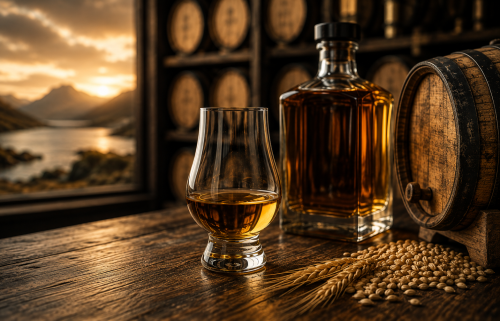
An accessible FAQ covering the basics of whisky: production, types, producing regions, age, cask influence, peat,...
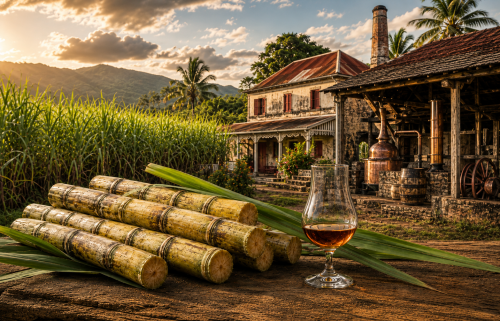
An accessible FAQ covering the basics of rum: production, raw materials, producing regions, styles, ageing, added...
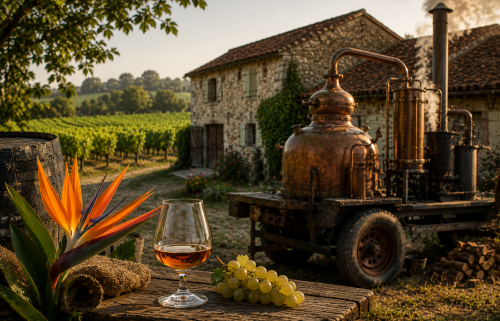
What is Armagnac? How does it differ from Cognac? What do VS, VSOP and XO mean? How should you choose, taste and...
Entretien exclusif avec Alexandre Vingtier. Il fait partie de ces esprits rares capables de penser le spiritueux à...

Entretien exclusif avec Alexandre Vingtier. Il fait partie de ces esprits rares capables de penser le spiritueux à...
No featured images
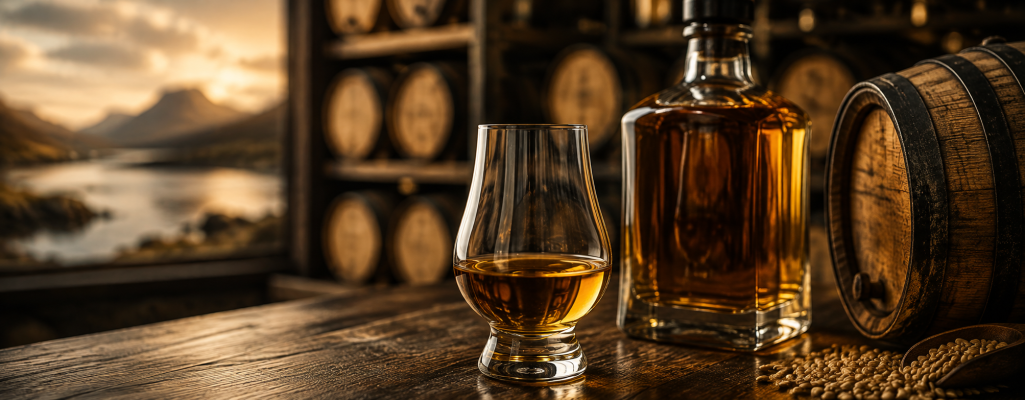
Whisky is made from cereals, water, and yeast. Beyond these common ingredients, production methods, regulations, and traditions vary considerably between countries and distilleries.
Single Malt, Blended Whisky, Bourbon, Scotch, Irish whiskey, age statements, sherry or bourbon casks, peat: these terms often come up when you first start exploring whisky, but they are not always easy to distinguish.
This FAQ answers ten essential questions, explaining how whisky is made, what distinguishes its main styles, how to understand certain terms found on bottles, and how to taste and store whisky under the right conditions.
Whisky is a spirit made from grains. Barley, maize, rye, or wheat may be used depending on the country, its traditions, and the desired style.
The grains are first processed to extract fermentable sugars. These sugars are then fermented by yeast, and the resulting liquid is distilled. Whisky generally continues to develop in casks, where it acquires much of its colour, texture, and aromas.
Behind this common principle lies remarkable diversity. Raw materials, distillation methods, ageing regulations, and production practices vary from one region to another. Scotch, Irish, American, and Japanese whiskies do not necessarily follow the same rules.
This diversity explains why two whiskies can have very different profiles: light and fruity, malty or grain-forward, spicy, oaky, or smoky.
The term whisky therefore refers to a broad family of grain-based spirits. To understand what truly distinguishes one bottle from another, it is important to consider how it is made, where it comes from, its category, and how it has been aged.
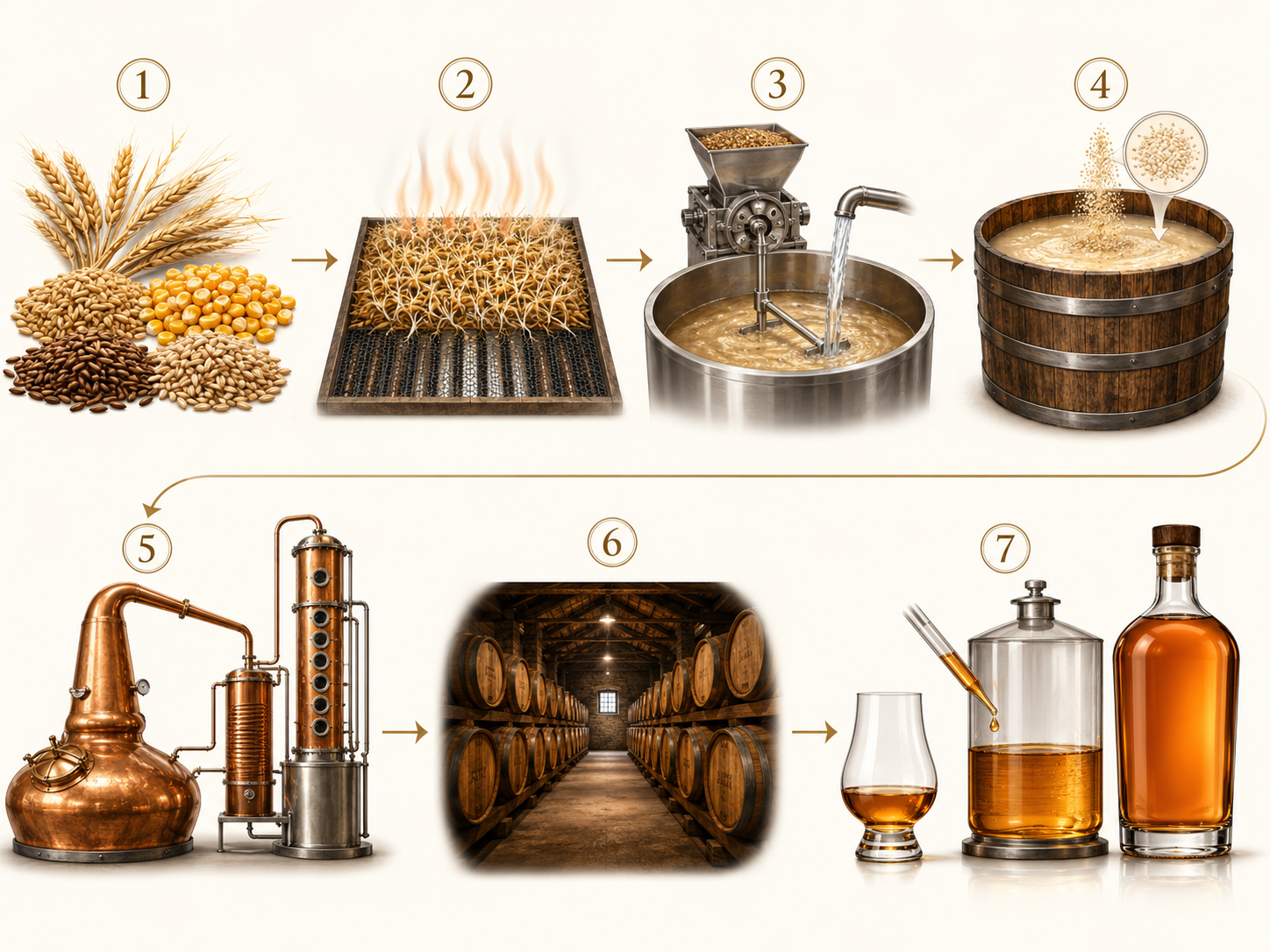
Whisky production involves a series of relatively straightforward steps: preparing the grains, extracting their sugars, fermenting them, distilling the resulting liquid, and finally maturing the spirit in casks. The decisions made at each stage are what ultimately give a whisky its character.
Production methods are not the same everywhere. The regulations governing Scotch Whisky, Bourbon, and Irish Whiskey differ in several respects. It is therefore worth looking at the main principles of whisky production before exploring the different categories.
1. Choosing the grains
Whisky is, above all, a grain-based spirit. Four grains play a particularly important role: barley, corn, rye, and wheat.
Barley is closely associated with Scotch whisky. Single Malt Scotch Whisky must be made exclusively from malted barley. Other categories of Scotch Whisky may, however, include other grains.
Corn plays a particularly important role in American whiskey production. It is the main grain used in Bourbon, which must contain at least 51% corn in its mash bill.
Rye is also widely used in North America and forms the basis of Rye Whiskey. It is often associated with spicier flavour profiles, although the final result naturally depends on the entire production process.
Wheat is used in many grain whiskies and certain blends. In the United States, it can also play an important role in some Bourbon recipes alongside corn.
Producers may therefore use one main grain or combine several, depending on the style they wish to achieve and the regulations they must follow.
2. Malting
When a grain is malted (barley being by far the most familiar example in whisky production), it is moistened to trigger germination.
This process helps develop the enzymes that will later convert the starch contained in the grain into fermentable sugars.
Germination is stopped by drying the grain. In some whiskies, particularly Scotch whiskies, peat may be used during this stage. The smoke introduces compounds into the malt that can give the finished whisky its characteristic smoky aromas. Of course, not all Scotch whiskies are peated.
3. Milling and mashing
The prepared grains are then milled. In the case of malted barley, the resulting ground grain is commonly known as grist.
It is mixed with hot water in a mash tun. The enzymes present in the malt then convert the starch into soluble sugars.
This produces a sugary liquid called wort, which is used for fermentation.
4. Fermentation
Once cooled, the wort is transferred to fermentation vessels, where yeast is added.
The yeast converts the sugars into alcohol. But its role goes beyond that: fermentation also produces numerous aromatic compounds that contribute to the character of the future whisky.
Fermentation times, yeast strains, and even the design of the fermentation vessels can vary from one distillery to another.
At the end of this stage, the result is a liquid with a relatively low alcohol content, sometimes compared to an unhopped beer.
5. Distillation
The fermented liquid is then distilled. The aim is not simply to increase its alcohol concentration: distillation also allows the producer to select which aromatic compounds to retain.
Two main types of still are commonly used.
Pot stills operate in batches. They are central to Single Malt Scotch Whisky production, which must be batch-distilled in this type of still at a single distillery. Traditionally, these stills are made of copper.
Column stills, by contrast, allow continuous distillation and are used in the production of many grain whiskies.
The size and shape of the still, the speed of distillation, and the selection of the fractions retained all have a direct influence on the character of the distillate.
6. Cask maturation
When it leaves the still, the distillate is generally clear. Much of its transformation then takes place during its time in the cask.
Through contact with the wood, the spirit gradually develops colour and new aromas. The type of oak, the age of the cask, its level of toasting or charring, and what it previously contained can all influence the result.
Regulations vary considerably between different types of whisky. To be called Scotch Whisky, for example, the spirit must be matured in Scotland for at least three years in oak casks with a maximum capacity of 700 litres. Scotch Whisky must also be bottled at a minimum alcoholic strength of 40% ABV.
Scottish producers use casks that previously held Bourbon, sherry, rum, wine, or certain other beverages, within the limits set by the Scotch Whisky regulations.
We will explore the role of casks in more detail later, as their influence on whisky is particularly significant.
7. Blending and bottling
Once maturation is complete, whisky is not necessarily bottled directly from a single cask.
Several casks may be combined to achieve the desired profile. Even a Single Malt can contain whiskies from several casks and different distillation years, provided they come from the same distillery and comply with the relevant category regulations. In Scotch whisky, Single Malt should therefore not be confused with Single Cask.
Whisky may then be diluted with water before bottling to achieve the desired alcohol strength. Some whiskies, however, are bottled without being diluted with water after maturation, retaining the natural alcoholic strength of the cask or combination of casks. These are generally described as Cask Strength.
From grain to glass, the overall process remains relatively simple. Yet a change in the grain recipe, fermentation, distillation, or cask can produce remarkably different whiskies. It is through these successive decisions that a distillery develops its distinctive identity.
The term whisky covers a wide range of categories. To understand them, it is important to distinguish between two things: how the whisky is produced (Single Malt, Blended Malt, Blended Whisky, etc.) and where it comes from, which may determine the regulations it must follow, as is the case with Scotch Whisky, Irish Whiskey, and Bourbon.
These terms do not all describe the same thing.
Single Malt
In the case of Scotch Whisky, a Single Malt is made exclusively from malted barley at a single distillery. In other countries, the term Single Malt may be subject to different requirements depending on local regulations.
The word Single does not mean that the whisky comes from a single cask. A Single Malt may be made from several casks, sometimes containing whisky distilled in different years, provided they all come from the same distillery.
This is a common misconception: Single Malt and Single Cask do not mean the same thing.
Single Grain
The term Single Grain can be misleading, as it does not necessarily mean that only one type of grain is used.
In Scotch Whisky, a Single Grain is produced at a single distillery but may be made from malted barley combined with other grains, whether malted or unmalted. It is generally distilled in column stills rather than pot stills.
Grain whiskies play an essential role in the production of blends.
Blended Malt
A Blended Malt Scotch Whisky is a combination of Single Malts from at least two different distilleries.
It therefore contains no grain whisky.
The term Pure Malt can still occasionally be found on older bottles or in certain commercial contexts, but Blended Malt is now the official category used for Scotch Whisky.
Blended Whisky
A Blended Scotch Whisky combines one or more Single Malt Scotch Whiskies with one or more Single Grain Scotch Whiskies.
The blender's role is to combine different whiskies to achieve a specific and consistent flavour profile. A blend is therefore not an "inferior" category to Single Malt: it simply follows a different approach to production.
Scotland also recognises a fifth official category, Blended Grain Scotch Whisky, which combines Single Grain whiskies from several distilleries. In total, Scotch Whisky regulations recognise five categories.
| Scotch Whisky category | Definition |
|---|---|
| Single Malt | Malted barley, one distillery |
| Single Grain | One distillery, other grains may be used |
| Blended Malt | A combination of Single Malts from different distilleries |
| Blended Grain | A combination of Single Grains from different distilleries |
| Blended Whisky | A combination of malt whisky and grain whisky |
What about Bourbon?
Bourbon is not a Scotch Whisky category: it is a type of American whiskey.
Its mash bill must contain at least 51% corn, and it must be aged in new, charred oak containers. These requirements play an important role in defining its identity and flavour profile.
Bourbon can be produced in different US states. It is therefore not exclusive to Kentucky, although the state has played a major historical role in its production.
What about Rye Whiskey?
American Rye Whiskey follows a similar principle to Bourbon, but rye is the main grain in the mash bill: it must account for at least 51% of the grains used.
Rye often contributes a spicier, livelier character, while corn is generally associated with rounder flavour profiles. However, these are broad tendencies: fermentation, distillation, and maturation remain decisive factors.
What is Irish Whiskey?
Irish Whiskey is a protected geographical indication and must be produced on the island of Ireland in accordance with its technical specifications.
There are several styles, including malt whiskey, grain whiskey, and blends. Ireland also has a particularly distinctive category: Single Pot Still Irish Whiskey, made from a mixture that includes both malted and unmalted barley.
Irish Whiskey should therefore not be defined simply by triple distillation. Although common, triple distillation is not a universal requirement for all Irish whiskeys.
What about Japanese whisky?
Japanese whisky developed largely through the historical influence of Scottish production methods. Since 2021, the Japan Spirits & Liqueurs Makers Association has introduced a voluntary standard for its members to better regulate the use of the term "Japanese Whisky". This framework improves transparency, but it does not yet constitute a nationwide legal definition comparable to that of Scotch Whisky.
Japanese whisky includes Single Malts and blends, among other styles. As elsewhere, the terminology used on a bottle must be understood in the context of the regulations applicable in the country concerned: the same designation does not necessarily imply exactly the same production requirements worldwide.
Whisky or whiskey?
Both spellings refer to the same broad family of spirits.
Whisky, without an "e", is commonly used in Scotland, Japan, and Canada. Whiskey, with an "e", is generally used in Ireland and the United States. This difference in spelling is mainly a matter of tradition and historical usage. It is primarily the regulations of each country that define the different whisky categories.
Key takeaways
To understand a whisky label more easily, it is important to distinguish between the whisky's category and its origin.
Single Malt Scotch Whisky indicates both a production method and a geographical origin. Bourbon refers to an American whiskey category defined in part by its mash bill and maturation requirements. Blended Malt, meanwhile, describes a combination of Single Malts from different distilleries.
These designations do not represent a hierarchy of quality. Above all, they help explain how a whisky was produced and which regulations govern it.
Whisky is now produced in many countries, but a few major regions have shaped its history and styles. Scotland, Ireland, the United States, Canada, and Japan remain the best-known whisky-producing countries, while India, Taiwan, Australia, and several European countries are playing an increasingly important role.
However, a whisky's origin alone is not enough to predict its flavour. Above all, it provides an indication of its production framework, traditions, and, in some cases, specific regulations.
Scotland remains one of the world's leading whisky-producing countries. To be called Scotch Whisky, a spirit must, among other requirements, be produced in Scotland and matured there for at least three years in oak casks.
Five main regions are commonly distinguished when discussing Scotch Whisky:
| Region | Characteristics often associated with the region |
|---|---|
| Speyside | Often fruity, floral whiskies or those influenced by sherry casks |
| Highlands | A vast region producing a wide variety of styles |
| Lowlands | Often associated with lighter, more delicate profiles |
| Islay | Famous for its many peated, smoky, and maritime whiskies |
| Campbeltown | Often rich whiskies with saline, fruity, or slightly smoky notes |
Ireland also has a long tradition of distillation. Irish Whiskey is a protected geographical indication and must comply with specific production requirements. In particular, its production and maturation must take place on the island of Ireland.
Several styles are produced, including Malt Irish Whiskey, Grain Irish Whiskey, Blended Irish Whiskey, and, perhaps most distinctively, Single Pot Still Irish Whiskey, which is closely linked to the country's history.
Triple distillation is often associated with Irish Whiskey, but it is not universal. Some producers use double distillation instead.
American whiskey is best known for Bourbon and Rye Whiskey, but production extends well beyond these two categories.
Kentucky is closely associated with Bourbon, but it can be produced elsewhere in the United States, provided the relevant regulations are followed. Bourbon must be made from a mash bill containing at least 51% corn and aged in new, charred oak containers.
Tennessee also has a strong whiskey-making tradition, while craft distilling has expanded across many other states.
Canada has been producing whisky for centuries and is particularly associated with Canadian Whisky and rye.
However, the term rye can be misleading: in Canada, its traditional use does not necessarily mean that rye makes up the majority of the grains used. Canadian whisky often relies on blending different grain whiskies.
This is a good example of why regulatory context matters: the same term can have different meanings depending on the country.
The history of Japanese whisky is more recent than that of Scotch or Irish Whiskey, but Japan has established itself as one of the major players in the industry.
Its production methods were strongly influenced by Scottish traditions, particularly in Single Malt production, but Japanese distilleries have gradually developed their own styles and practices.
Since 2021, a voluntary standard introduced by the Japan Spirits & Liqueurs Makers Association has established stricter requirements for the use of the term "Japanese Whisky" among its members. In particular, it aims to distinguish whiskies genuinely produced and matured in Japan from those that are merely blended or bottled there.
India has also become an important whisky-producing country, particularly through the development of Single Malts aimed at international markets.
The hot climate has a significant influence on maturation. Interaction with the wood and evaporation can be more intense than in Scotland, causing whisky to develop differently in the cask.
However, the age of an Indian whisky should not be compared directly with that of a Scotch. Fewer years in the cask do not necessarily mean that the whisky has undergone less maturation.
Whisky is no longer produced exclusively in a handful of countries with long-established traditions.
Today, recognised whisky producers can be found in Taiwan, Australia, France, Sweden, Germany, Switzerland, and New Zealand, among many other countries.
This international expansion has considerably broadened the whisky landscape. Producers work with their own grains, climates, cask types, and local traditions, sometimes drawing inspiration from the established Scottish, Irish, or American approaches to whisky-making.
When a bottle displays an age statement of 10, 12, or 18 years, this figure refers to the time the whisky spent maturing in casks before bottling.
For Scotch Whisky, the rule is clear: when an age is stated, it must correspond to the youngest whisky in the bottle. A blend may therefore contain much older whiskies without this being reflected on the label.
Not necessarily.
A 12-year-old Single Malt may be created by combining whisky from numerous casks. Some may be 12 years old, others 14, 16, or even older. As long as none of the whisky used is younger than 12 years, the bottle can carry that age statement.
This is an important distinction: the age statement is not an average.
If a blend contains whiskies aged 12, 15, and 20 years, for example, the age stated on the label will be 12 years.
The same principle of declaring the youngest whisky also applies under certain American regulations when an age statement is required for a blend. The Alcohol and Tobacco Tax and Trade Bureau (TTB) specifies, for example, that a blend of 2-year-old and 3-year-old whiskies may carry an age statement of 2 years, rather than an average of the two.
A whisky's age refers to the period during which the spirit matures in casks after distillation.
Time spent in the bottle does not add to this age. A bottle of 12-year-old whisky kept in a private collection for twenty years therefore remains a 12-year-old whisky.
This is an important difference from wine: once bottled, whisky does not continue to age in the same way as it does when in contact with wood.
No.
Many whiskies are sold without an age statement. These are commonly referred to as NAS whiskies, meaning No Age Statement.
This does not mean that the whisky has not been matured. It must still comply with any minimum maturation periods required for its category. A Scotch Whisky without an age statement must therefore have spent at least three years in oak casks, just like any other Scotch Whisky.
Not displaying an age statement allows producers to combine casks of different ages without having to declare the age of the youngest whisky.
No.
An age statement tells you how long a whisky has matured, not how good it is.
Over time, wood can contribute greater complexity, but extended maturation is not automatically beneficial. A particularly active cask can eventually overpower the character of the distillate, introduce excessive tannins, or upset the whisky's balance.
Conversely, a relatively young whisky can be perfectly mature if the distillate, cask, and maturation conditions work well together.
Climate also plays an important role. Ten years of maturation in Scotland will not necessarily have the same effect as ten years in a much warmer climate. Temperature, humidity, and seasonal variations influence the interaction between the spirit and the wood, as well as evaporation.
Age can nevertheless help explain part of the price.
The longer a whisky remains in a cask, the longer the producer must hold stock and allocate warehouse space. Some of the liquid also gradually disappears through evaporation, a phenomenon commonly known as the angel's share.
After several decades, the volume remaining may therefore be considerably lower than the amount originally filled into the cask. The rarity of old stocks, a particular distillery, or a specific vintage can also contribute to the price.
A high price may therefore reflect scarcity and the time required to produce the whisky, without necessarily guaranteeing that it will be better for the person drinking it.
The cask does more than simply store whisky. During maturation, the spirit interacts with the wood and gradually changes: it develops colour, acquires new aromas, and its texture evolves.
The cask plays such an important role that Scotch Whisky regulations specifically require maturation in oak casks, with the wood contributing to the whisky's character and colour.
Wood contains various compounds that can gradually pass into the whisky during maturation. Depending on the type of oak, the level of toasting or charring, the age of the cask, and its previous use, the whisky may develop notes of vanilla, spices, coconut, dried fruit, caramel, or toasted wood.
But the cask does more than contribute aromas. During maturation, extraction, oxidation, evaporation, and chemical reactions gradually take place. Some compounds diminish, while others emerge or evolve, progressively changing the whisky's character.
The final result therefore depends as much on the original distillate as on how it is matured.
This is one of the major differences between whisky-making traditions.
In the United States, Bourbon must be aged in new, charred oak containers. This gives the wood a particularly strong influence from the earliest years of maturation.
In Scotland, the situation is very different. Producers make extensive use of casks that have previously held other beverages, particularly Bourbon, sherry, wine, or rum. Scotch Whisky regulations currently permit new oak as well as several categories of casks previously used to mature wines, beers, or spirits, subject to certain conditions.
A previously used cask generally has a less pronounced extractive influence than new oak, but its previous contents can still leave a significant imprint on the whisky.
These are two of the most iconic cask types used in Scotch Whisky maturation.
An ex-Bourbon cask may contribute notes of vanilla, caramel, coconut, or sweet spices.
Casks that previously held sherry are often associated with richer profiles, featuring notes of dried fruit, nuts, spices, or chocolate.
However, these descriptions should be treated with caution. An ex-Bourbon cask will not automatically produce a vanilla-forward whisky, just as a sherry cask will not necessarily create a raisin-like profile. The type of oak, the cask's previous use, its level of toasting or charring, what it previously contained, and the length of maturation all play a role.
In Scotch whisky, the terms first fill, second fill, and, more generally, refill are frequently used.
A first fill cask is one used for the first time to mature Scotch Whisky after previously holding, for example, Bourbon or sherry. It generally retains a significant aromatic influence.
When the cask is reused to mature another Scotch Whisky, its influence gradually becomes more subtle. A refill cask can therefore allow more of the distillate's original character to come through.
This does not mean that a first fill cask is better than a refill cask. Both may be desirable depending on the intended result.
Finishing, also known as secondary maturation or cask finishing, involves transferring an already matured whisky into another cask for an additional period.
For example, a whisky may spend most of its maturation in an ex-Bourbon cask before being transferred into a cask that previously held sherry, port, or rum.
Finishing extends the maturation process in a different cask, generally after an initial period of ageing elsewhere. The cask must be emptied of its previous contents: it is the interaction with the wood and the compounds retained within it that influences the whisky's development.
Yes.
In a smaller cask, the ratio of wood surface area to whisky volume is higher. Contact with the wood can therefore be more intense. However, this does not automatically mean that a smaller cask produces better whisky or can replicate the results of long maturation in just a few years.
Cask size is only one of many factors. Climate, warehouse temperature, the alcoholic strength at which the spirit is filled into the cask, and the condition of the wood also play important roles.
For Scotch Whisky, casks must have a maximum capacity of 700 litres.
Very much so.
In a warm climate, interaction between the spirit and the wood, as well as evaporation, can be more intense. In cooler climates, these processes generally follow a different rhythm. This does not mean that whisky matured in a warm climate strictly "ages faster", but rather that maturation takes place under different conditions.
This is one reason why direct comparisons between the age of a Scotch Whisky and that of a whisky produced in India, Taiwan, or another warm region should be approached with caution.
Time spent in the cask remains important, but ten years of maturation will not necessarily produce the same result everywhere in the world.
The peaty character of certain whiskies develops long before cask maturation. It generally originates during the drying of malted barley, when peat is used as a fuel.
The smoke passes through the still-damp malt, depositing aromatic compounds onto the grains. Some of these compounds survive fermentation, distillation, and maturation, which explains why smoky notes can still be present in whisky many years later.
Peat is an organic material that forms very slowly in wetlands from partially decomposed vegetation.
For many years, it was used as a fuel in several regions of Scotland. Its use in whisky production was therefore originally linked to local practices before becoming a deliberate stylistic choice.
Today, some distilleries continue to use peat to give their whisky a distinctive aromatic character.
After germination, malted barley must be dried.
When peat is burned during this stage, its smoke comes into contact with the grains. It introduces various compounds, particularly phenols, which can later give the whisky aromas reminiscent of smoke, ash, damp earth, medicinal herbs, tar, or sometimes more maritime notes.
However, the result depends greatly on the type of peat used and how it is burned. Not all peated whiskies therefore have the same flavour profile.
Not quite.
Peated generally describes the origin of the aromatic character: peat was used during the drying of the malt.
Smoky describes a sensory impression when tasting the whisky.
A peated whisky is therefore often smoky, but smokiness can take many different forms. Some whiskies evoke a wood fire or cold ash, while others develop more medicinal, earthy, or herbal notes.
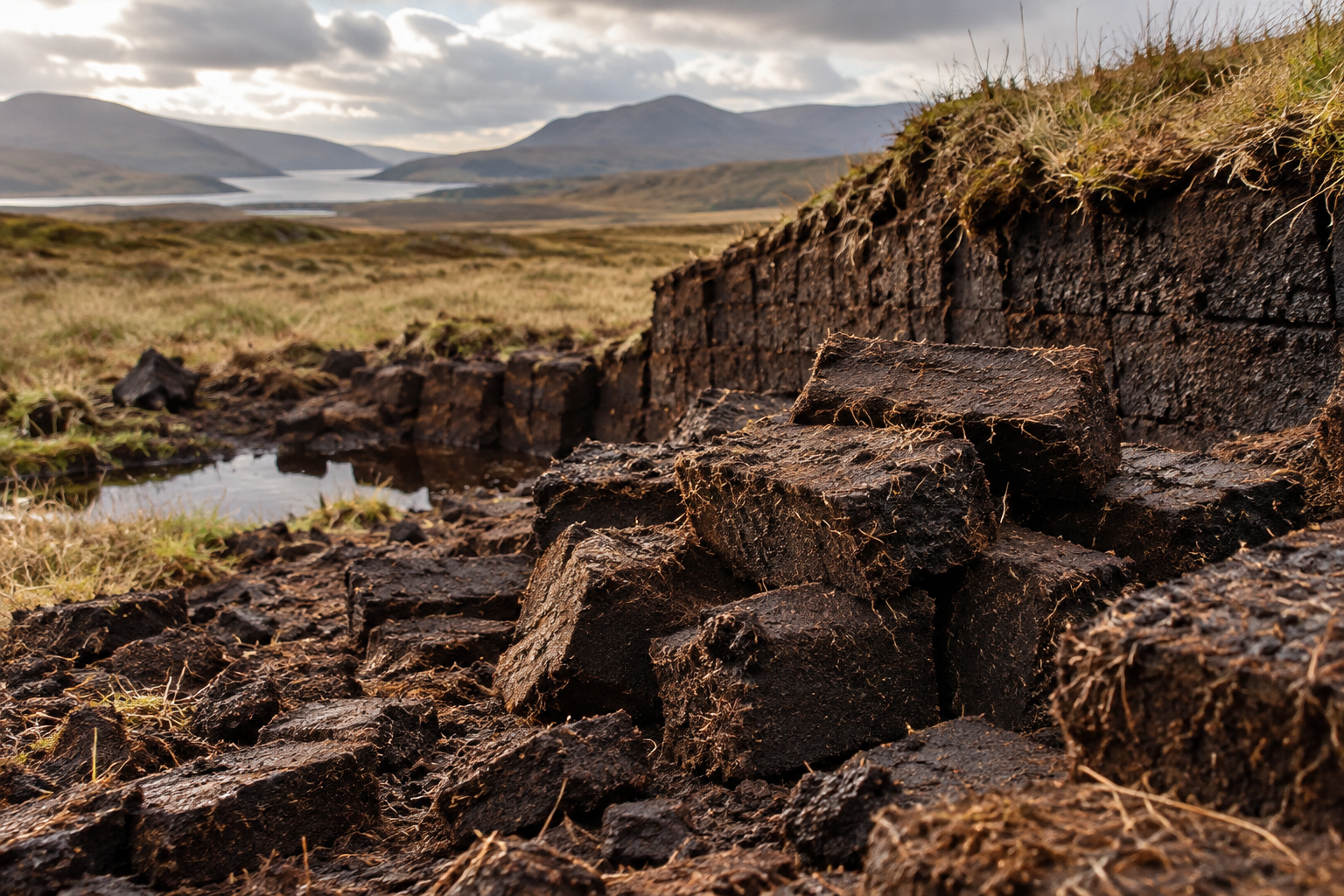
Scottish peat bog
The intensity depends partly on how much smoke the malt is exposed to and how long the drying process lasts.
But these are not the only factors. Fermentation, distillation, the selection of distillation cuts, and maturation all influence how these aromas are expressed in the finished whisky.
This is why two whiskies made from heavily peated malt can deliver very different experiences in the glass.
You may sometimes come across a value expressed in ppm, meaning parts per million.
In this context, the stated value most commonly refers to the concentration of phenolic compounds measured in the malt before distillation. It therefore provides an indication of how heavily the barley has been peated.
However, this figure should be interpreted with caution. It does not directly measure how smoky the finished whisky will taste. Some of these compounds change or disappear during production and maturation.
A whisky with a higher ppm value is therefore not automatically smokier on the palate.
No.
Islay is particularly famous for its peated whiskies, which explains why the island is so closely associated with this style. However, many distilleries elsewhere in Scotland also produce peated whiskies.
Conversely, a whisky from Islay is not necessarily heavily smoky.
Geographical origin can therefore provide a clue, but it cannot, on its own, determine how peated a whisky will be.
Yes.
Over time, peat-derived aromas evolve alongside those of the distillate and the cask. In some older whiskies, the smoke may seem less pronounced, more integrated, or more complex.
This does not necessarily mean that the peat character disappears. Rather, the way it is perceived changes throughout maturation.
These three terms frequently appear on whisky bottles, particularly those released by independent bottlers. They describe different aspects of the whisky: Single Cask refers to its origin from a particular cask, Cask Strength to its alcoholic strength at bottling, and Non-Chill Filtered to how it was filtered before bottling.
They therefore provide useful information about how the whisky has been bottled, but they are not, in themselves, a guarantee of quality.
A Single Cask whisky comes from one individual cask.
Unlike a standard bottling, where several casks may be combined to achieve a consistent flavour profile, a Single Cask reflects the character of one particular cask at a given point in time.
This also means that the number of bottles available is naturally limited by the amount of whisky contained in that cask.
It is particularly important not to confuse Single Cask with Single Malt.
A Single Malt may come from several casks, provided the whisky was produced at the same distillery. Single Cask, on the other hand, simply means that the whisky comes from one cask.
Because no two casks mature in exactly the same way.
Even when two casks are filled on the same day with the same distillate, differences in the wood, their previous use, their position in the warehouse, or the amount of evaporation can produce different results.
This is precisely part of the appeal of Single Cask whisky: it reveals a particular expression of a distillery rather than a flavour profile deliberately reproduced from one batch to another.
A Cask Strength whisky is generally bottled at the natural alcoholic strength reached during maturation in the cask or casks, without dilution with water before bottling.
It therefore often has a higher alcohol content than whiskies bottled at 40%, 43%, or 46% ABV.
When several casks are combined, the final alcoholic strength is that of the resulting combination. However, the term Cask Strength is not defined in exactly the same way under every regulatory framework and is partly based on established industry practice.
The essential principle is that the whisky has not been diluted with water to achieve a lower bottling strength.
Not necessarily.
A higher alcohol content can offer greater concentration and allow the drinker to adjust the whisky to their preference by adding a few drops of water. However, this does not mean that a whisky bottled at 55% or 60% ABV will automatically be more complex or interesting than one diluted to 46% ABV.
Bottling strength is a choice made by the producer, not a measure of quality.
Whisky naturally contains certain compounds, particularly fatty acids and their esters, which can become less soluble when the temperature drops or the alcoholic strength is reduced.
As a result, the whisky may become slightly cloudy or develop a haze under certain conditions.
To prevent this, some producers use chill filtration. The whisky is cooled and then filtered to remove some of the compounds that could cause this cloudiness.
The main purpose of this process is to ensure that the whisky remains perfectly clear in the bottle.
The term Non-Chill Filtered, often abbreviated to NCF, indicates that the whisky has not undergone chill filtration.
It may therefore become slightly cloudy when chilled, when water is added, or when bottled at a relatively low alcoholic strength.
This is a natural phenomenon and does not mean that the whisky is faulty.
Some producers and whisky enthusiasts prefer to avoid chill filtration in order to retain as many of the whisky's naturally occurring compounds as possible. However, claiming that a non-chill filtered whisky is necessarily better or more aromatic would be too simplistic. The sensory impact of chill filtration is much harder to isolate than its visual effect.
A fourth term often appears alongside the previous three: Natural Colour.
It generally means that the whisky's colour comes entirely from cask maturation and that no caramel colouring has been added to standardise or alter its appearance.
This is separate from chill filtration: a whisky can be non-chill filtered and still contain added colouring, or vice versa.
The colour of a whisky should not automatically be taken as an indication of its age or quality. A relatively young whisky matured in a very active cask can be quite dark, while a much older whisky from a less active cask may remain fairly pale.
There is no single correct way to enjoy whisky. Some prefer it neat, others with a few drops of water, and some over ice. To truly discover its flavour profile, the most important thing is to taste it under the right conditions and take the time to appreciate it.
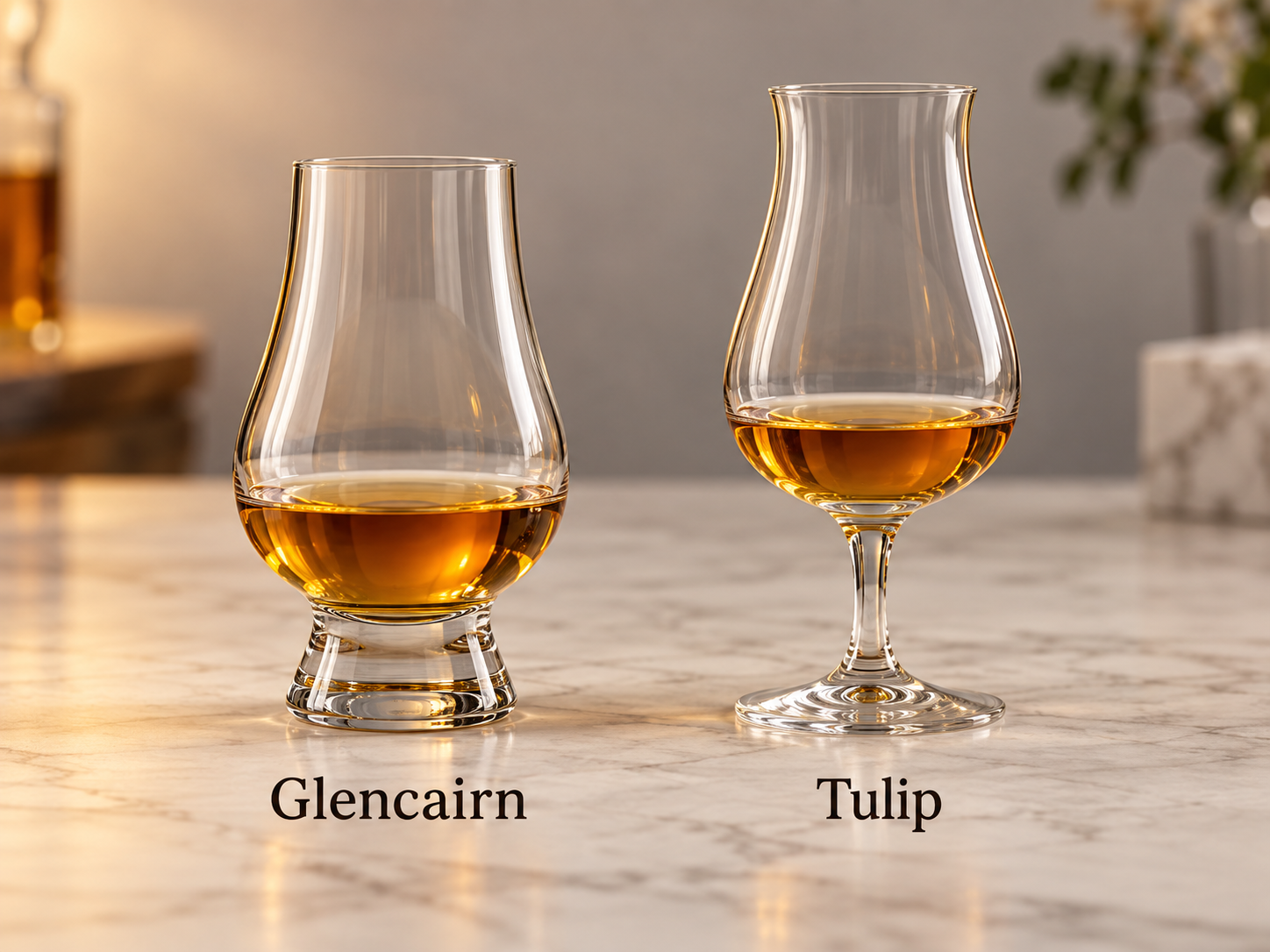
A glass that narrows towards the rim, such as a Glencairn or tulip-shaped glass, is generally preferable for a more focused tasting experience. Its shape concentrates the aromas, making them easier to appreciate.
A wide tumbler is perfectly suitable for enjoying whisky in a more relaxed setting, but it allows the aromas to disperse more readily.
Whisky generally expresses itself well at room temperature or slightly below.
There is no need to warm it. Conversely, whisky that is too cold may seem less expressive aromatically.
The best approach is to avoid extremes and let the glass rest for a few minutes before tasting.
It is best not to put your nose straight into the glass, especially with a high-strength whisky.
Instead, bring the glass towards your nose gradually, breathing gently. Take short sniffs and move the glass slightly away between each one.
On the first nosing, you will often notice the most obvious aroma families: fruit, cereals, vanilla, spices, smoke, and wood. When you return to the glass a little later, other nuances may emerge.
Yes, if you wish.
A few drops of water can make certain whiskies more expressive, particularly those bottled at a high alcoholic strength.
Water reduces the sensation of alcohol and can change the aromatic balance in the glass. However, this does not mean that whisky should always be diluted. Some are more expressive neat, while others benefit from a little water.
With a Cask Strength whisky, it can be interesting to taste it neat first, then gradually add a few drops of water to observe how it develops.
Ice cubes quickly cool the whisky and gradually dilute it as they melt.
This can be enjoyable depending on how you prefer to drink your whisky, but the cold also suppresses some of its aromas. If your aim is to analyse a whisky, it is therefore better to start without ice.
For pure enjoyment, however, there is no reason to discourage someone from adding an ice cube if that is how they prefer their whisky.
Take a small sip and let the whisky rest in your mouth for a few moments.
The first impression is often dominated by alcohol, especially with a powerful whisky. A second sip generally makes it easier to appreciate the flavours.
You can then consider several elements:
Texture: light, oily, creamy, or dry;
Flavours: fruity, cereal-like, spicy, woody, or smoky;
Balance: between alcohol, sweetness, bitterness, and acidity;
Finish: how long the flavours linger after swallowing.
There is no need to search for dozens of tasting descriptors. Describing a whisky as fruity, dry, smoky, or spicy is already a perfectly valid tasting assessment.
Yes, particularly if it is high in alcohol.
A few minutes in the glass may be enough for certain aromas to become more apparent. With a high-strength whisky, allowing it to rest can also make nosing more comfortable.
However, there is no universal waiting time. Some whiskies open up very quickly, while others continue to evolve over half an hour or more.
Whisky keeps very well when protected from light, heat, and significant temperature fluctuations.
Unlike wine, whisky bottles should be stored upright. Prolonged contact between a high-strength spirit and the cork can damage it.
A cupboard or a cool, temperature-stable cellar, away from direct sunlight, is generally ideal.
An opened bottle can remain in good condition for several years if it is properly sealed and stored.
The main change comes from the air inside the bottle. As the whisky level falls, the proportion of air increases, and the whisky may gradually change over time.
When very little liquid remains, some aromas may progressively lose their intensity. For bottles you intend to keep for a long time, it can be helpful to avoid opening them repeatedly and to minimise exposure to heat and light.
No. Once bottled, whisky no longer continues to age as it would in a cask.
A 12-year-old whisky kept in a sealed bottle for another twenty years therefore remains a 12-year-old whisky. Time spent in the bottle does not add to the age stated on the label.
Whisky maturation largely depends on the interactions between the spirit, the wood, and the warehouse environment.
During its time in the cask, whisky extracts certain compounds from the wood, while other reactions take place slowly over time. It is during this stage that its colour, texture, and much of its aromatic profile develop.
Once transferred into a glass bottle, these interactions almost entirely cease. Glass is inert and does not play the same role as wood.
The whisky therefore enters a much more stable phase.
Very slightly, particularly if it is not stored properly.
A properly sealed bottle, stored upright and protected from light and significant temperature fluctuations, can remain stable for many years.
However, excessive heat, prolonged exposure to sunlight, or a faulty cork can gradually affect the whisky.
An old bottle is therefore not automatically better than a recent one. Its condition depends greatly on how it has been stored.
Once a bottle is opened, the whisky comes into greater contact with air.
These changes generally remain slow while the bottle is still relatively full. They become more noticeable as the level drops, because the proportion of air inside the bottle increases.
Over time, some aromas may lose intensity or change slightly. The whisky may seem less expressive or different from how it tasted when first opened.
However, it does not start ageing again. These changes are instead linked to oxygen exposure and volatile compounds.
It can be, but for reasons other than the time it has spent in the bottle.
An older bottling may reflect a period when a distillery used different production methods, different types of casks, or a different distillate character. Some bottles also come from closed distilleries or stocks that no longer exist.
In such cases, their appeal may be historical, related to their flavour profile, or linked to their rarity.
However, a bottle from 1970 containing a 10-year-old whisky has not become a whisky aged over 60 years today. It still contains whisky that was at least 10 years old when it was bottled.
Whisky cannot be defined solely by its age, origin, or the information displayed on its label. Its identity begins with the choice of grains and develops through malting, fermentation, distillation, and, above all, cask maturation.
Understanding these key principles makes it easier to distinguish a Single Malt from a blend, a Scotch from a Bourbon, to understand what terms such as Cask Strength or Non-Chill Filtered actually mean, and to interpret a whisky's age or level of peatiness more accurately.
This FAQ provides the essential foundations for approaching whisky with a more informed perspective. Above all, it demonstrates that there is no single whisky style, but rather a remarkable diversity of traditions, climates, raw materials, and production choices.
The best way to continue exploring whisky is to compare different origins, distilleries, cask types, and bottling methods, without assuming that one category, age statement, or higher alcoholic strength is automatically superior to another.
The regulatory and technical information presented in this article has been checked against the following sources, among others:


 Armagnac: Answers to the 10 Most Frequently Asked Questions
Rum: Answers to the 10 Most Frequently Asked Questions
Armagnac: Answers to the 10 Most Frequently Asked Questions
Rum: Answers to the 10 Most Frequently Asked Questions

Leave a comment