From Trelawny to independent bottlings, explore Hampden’s history, fermentation methods, marks and the rums in our...
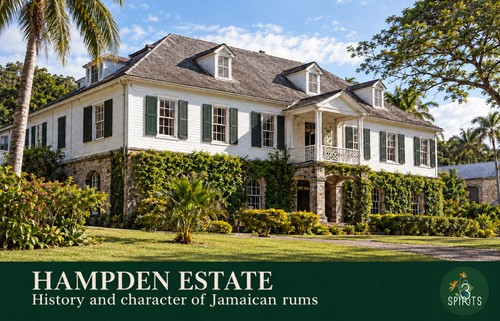
From Trelawny to independent bottlings, explore Hampden’s history, fermentation methods, marks and the rums in our...
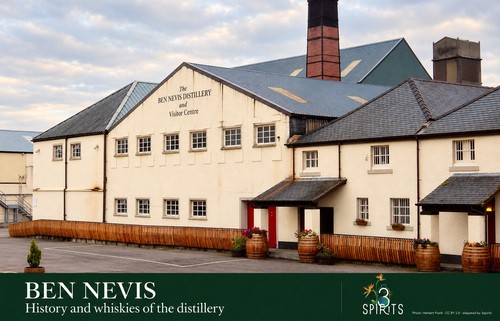
At the foot of Ben Nevis, this Highland distillery has been making whisky since 1825. Discover its history, its ties...
An accessible FAQ covering the basics of whisky: production, types, producing regions, age, cask influence, peat,...
An accessible FAQ covering the basics of rum: production, raw materials, producing regions, styles, ageing, added...
What is Armagnac? How does it differ from Cognac? What do VS, VSOP and XO mean? How should you choose, taste and...
No featured images
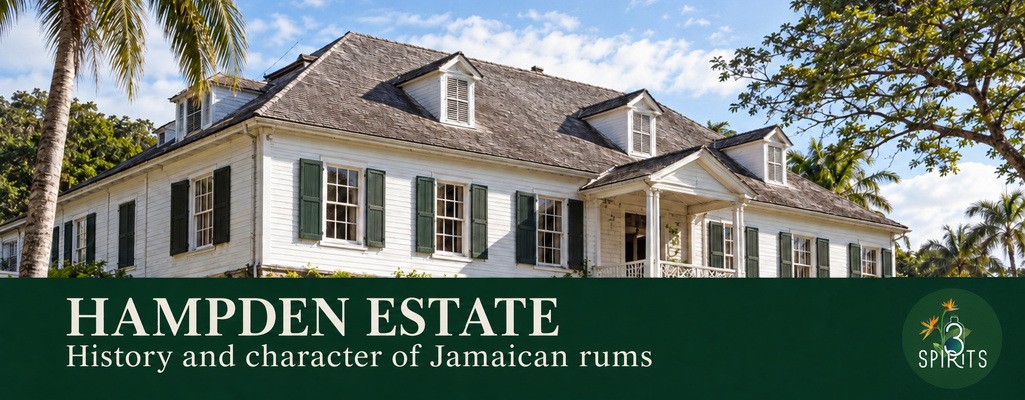
Founded in 1753 in Trelawny parish, an administrative district of Jamaica, Hampden Estate spent much of its history supplying rum to merchants and blenders. Today, its name appears on both official bottlings and independent selections. 1, 4
Wooden vats, fermentation with yeasts living at the distillery, copper pot stills: Hampden’s character begins to take shape long before maturation. The distillery produces several styles of rum, identified by codes such as OWH, HGML and DOK. These ‘marks’ offer a way into the diversity of its craft. 2, 3, 5
Hampden lies in north-western Jamaica, near Cockpit Country. The approach to the estate passes through sugarcane fields before reaching the Great House, the former estate house built in the late eighteenth century beside the distillery. 1, 2
The water used in production comes from a natural spring a few kilometres away. The distillery considers it one of the foundations of its method, alongside fermentation, copper stills and tropical ageing. 3
The estate’s history is part of the story of Jamaica’s sugar economy. Its official timeline takes 1753 as a reference point, when Hampden operated as a large sugar plantation owned by the Scotsman Archibald Stirling.
The Great House was built in 1779. Its ground floor served as a rum store until the early twentieth century. After several changes of ownership, the Farquharson family ran the estate until 2003, when it passed to the Jamaica Sugar Company.
In 2009, Everglades Farms, owned by the Hussey family, acquired Hampden. According to the distillery, ageing on the estate began in 2010, followed in 2018 by the commercial launch of its first official aged rum bottlings. 1
That later date does not mark the arrival of the first Hampden rums: the estate had been supplying European markets long before developing this range under its own name. 1, 4
In an interview with Rum Auctioneer, Christelle Harris recalls sharing samples of Hampden aged in Jamaica with Luca Gargano at the 2015 UK Rumfest. Her mother had brought them from the island. That encounter helped pave the way for their collaboration: people, conversations and tastings also have a place in the story of these bottlings. 18
Hampden works with molasses, the thick, dark liquid left after sugar crystals have been extracted from sugarcane. It still contains sugars that yeasts can turn into alcohol. This transformation is called fermentation. 19
At Hampden, fermentation takes place in wooden vats with indigenous yeasts: yeasts present in the distillery’s environment. These microorganisms consume sugars and help develop aromas. 2, 3, 19
Depending on the style being produced, the recipe may also include cane vinegar, dunder or muck. The last two terms refer to different things. 4, 18
Dunder is the liquid left in a pot still after a distillation run. Hampden keeps it for use in certain preparations. Muck is a separately maintained mixture rich in bacteria and acids that helps develop the desired aromas. Christelle Harris stresses that the terms are not interchangeable: they describe two distinct parts of the distillery’s craft. 18
The time required varies with the recipe. The distillery’s general introduction mentions eight to fifteen days; the 8 Marks documentation also details a resting period after alcoholic fermentation. At this stage, the liquid is known as dead wash. For DOK, the stated cycle reaches twenty-five days, including the rest. This extra time helps develop compounds that contribute to the rum’s character. 2, 4
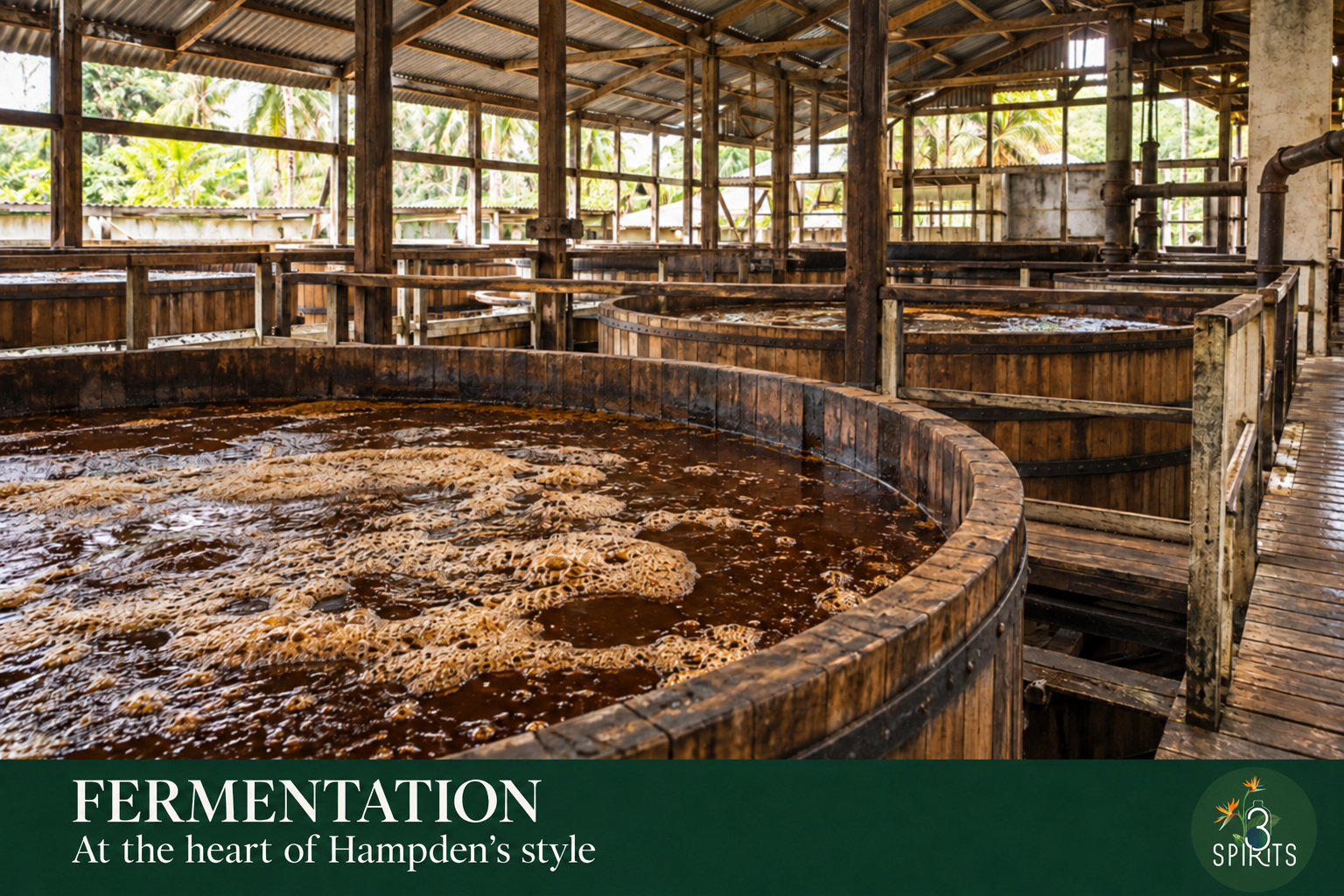
AI-generated illustration: a visual evocation, not a documentary image of Hampden’s actual facilities.
Distillation involves heating the fermented liquid, collecting its vapours and cooling them to obtain a liquid with a higher alcohol concentration. This liquid is the distillate: it has yet to gain colour and flavours from cask ageing. 19
Hampden uses pot stills, which operate in batches. They are fitted with two retorts, vessels connected to the pot through which the vapours pass. These additional stages help concentrate the alcohol before the vapours are finally cooled. 3, 10, 19
The distillery’s presentation notably describes a John Dore installed in 1960, a Vendome dating from 1994, a Forsyth brought into service in 2010 and a TNT added in 2016. These names refer to still manufacturers. 2
The resulting rum already carries the character of its recipe. Time in a cask then develops this aromatic foundation.
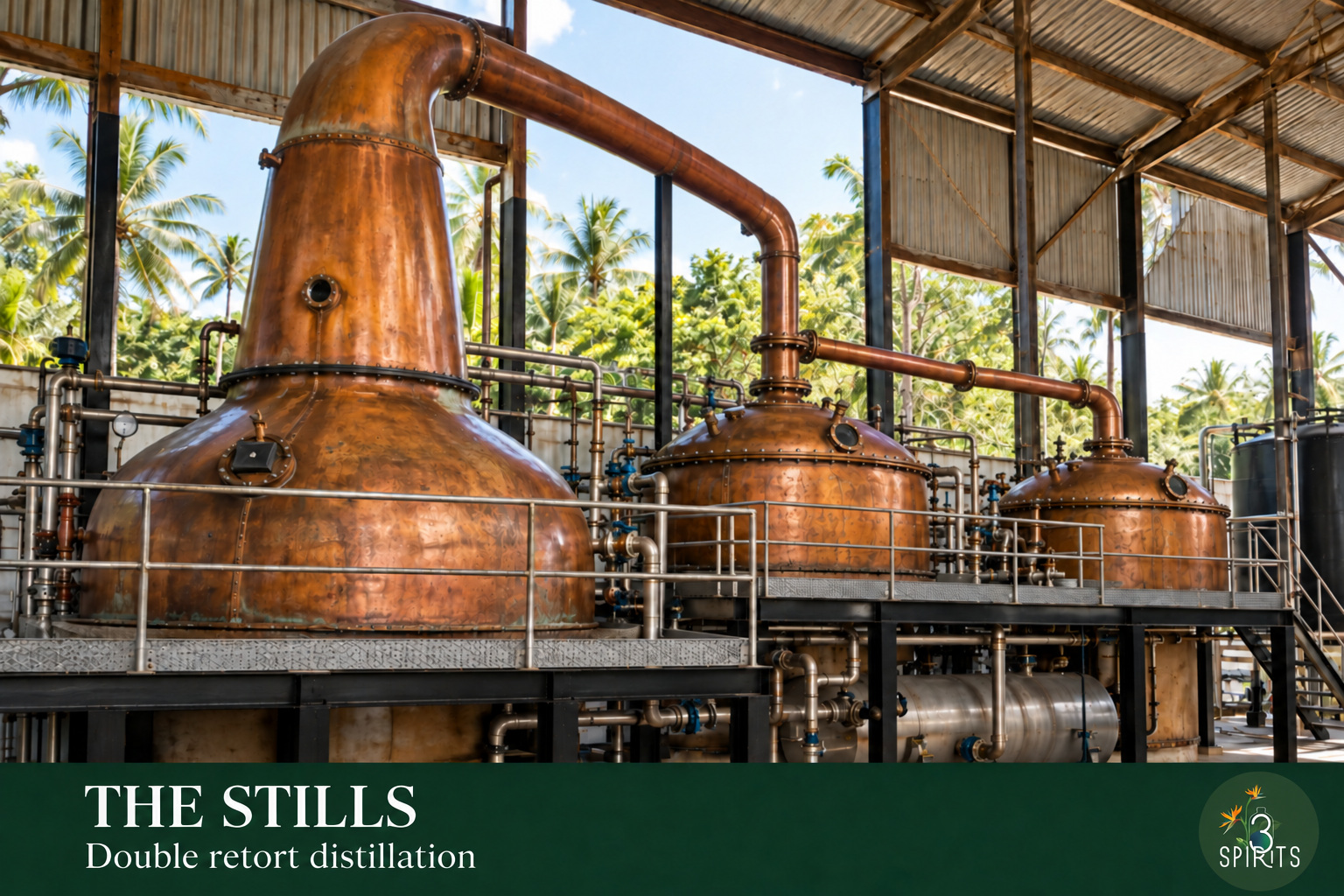
AI-generated illustration: a visual evocation, not a documentary image of Hampden’s actual facilities.
Esters are a family of compounds formed, among other ways, through interactions between acids and alcohols during fermentation and distillation. Some contribute floral or fruity impressions that may recall pears, pineapple or bananas. 4
Their diversity matters as much as their quantity. A total ester figure alone cannot describe all of a rum’s aromas: other compounds also shape its identity. 16
Funk, a word often used for Jamaican rum, is a tasting term with no unit of measurement. It can suggest a combination of fruity, fermentative or more unusual impressions. When comparing two bottles, a precise description is more helpful than the word alone.
It is also important to distinguish ester concentration from alcohol strength. Here, the former is expressed in grams per hectolitre of pure alcohol; the latter is the alcohol percentage shown on the bottle. For example, ‘1,500 g/hl of pure alcohol’ gives an ester quantity relative to 100 litres of pure alcohol. It does not mean that the rum is 1,500% ABV. 17
A mark is a code identifying a production recipe and a style of new-make rum. It brings together choices about raw materials, fermentation and distillation. Historically, these codes helped identify rums sold in bulk and used in blends. 16, 17
| Mark | Esters (g/hl of pure alcohol) |
|---|---|
| OWH | 40–80 |
| LFCH | 80–120 |
| LROK | 200–400 |
| HLCF | 400–600 |
| <>H | 900–1 000 |
| HGML | 1 000–1 100 |
| C<>H | 1 300–1 400 |
| DOK | 1 500–1 600 |
Ranges published for the official unaged 8 Marks Collection. They describe the marks’ ester ranges, rather than laboratory results for every bottle after ageing. 5
OWH and LFCH sit at the lower end of this scale; C<>H and DOK occupy its most concentrated end. This is not a ranking of quality.
A mark helps place a bottle in context before looking at its age, cask, maturation locations and bottling strength. Two rums bearing the same code can therefore offer different expressions.
The official descriptions show several sides of the style. For The Younger, a five-year-old rum made from the LROK mark, the distillery describes fresh pineapple, ripe tropical fruit and a spicy, peppery finish. 6
For its eight-year-old rum, it instead describes caramelised apple, sweet spices and a delicate smoky touch. These notes belong to a specific bottling; they are not a universal description of Hampden. 7
Independent selections provide further examples. The product page for our Hampden DOK 2009 from The Whisky Jury mentions ripe banana alongside impressions of varnish and thinner. These words describe perceived aromatic similarities, rather than ingredients added to the rum. 11
Tasting descriptions offer useful pointers, while the mark, cask and age remain essential to understanding the particular expression in the glass.
Here, tropical ageing means maturation in Jamaica’s hot, humid climate. In the vocabulary of these selections, continental ageing generally means maturation in Europe. Location and climate are part of a cask’s journey. 8, 16
The 8 Marks Collection aged for one year in ex-bourbon casks — casks previously used for bourbon, an American whiskey — offers a way to explore what this maturation adds to the eight distillates. 8, 19
The rum extracts compounds from the oak and evolves in contact with its cask. Climate, time and the characteristics of the vessel all contribute to the result: age alone does not tell the whole story. 16
Independent selections need to be considered individually. The product page for The Roots’ HD 2013, for example, specifies that part of its ageing took place in a tropical climate. A Jamaican origin therefore does not establish that all maturation occurred at Hampden. 12
When comparing two bottles, it helps to look beyond age and follow the cask’s journey: where did the rum mature, in what kind of vessel, and for how long in each place?
An official bottling belongs to the distillery’s own range. An independent bottler selects rums from producers and markets them under its own name. It may offer a single cask or a blend bringing together several rums. The vintage identifies the year of distillation. 9, 11, 15
At 3spirits, this approach is represented by The Whisky Jury, as well as by The Roots and Swell de Spirits in our catalogue. 9, 11, 12, 13
Two releases in The Ester Hunter series show why reading the full label matters: Catch 5, HD C<>H 2018, was bottled at 64.3% ABV, while Catch 9, also HD C<>H 2018, comes in at 63.9%. Vintage and mark alone are therefore not enough to identify a selection. 9, 14
A rum made entirely at Hampden should also be distinguished from a blend containing it. The Whisky Jury’s The Duo Chapter 4 brings together a Long Pond 1998 and a Hampden 2014. 15
Here are several references from our selection. Each product page shows its current availability.
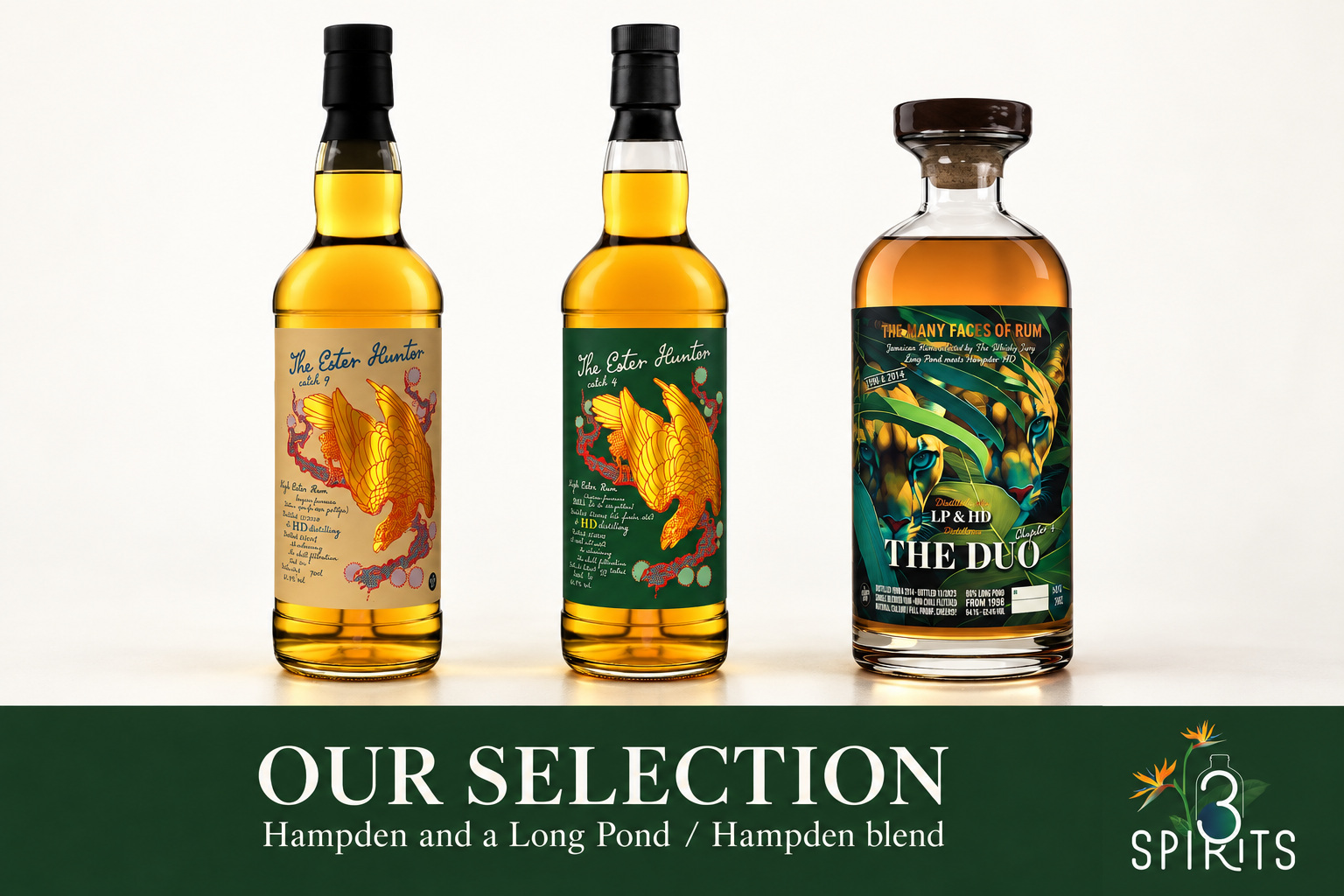
| Bottling | Age, ABV and volume | Details |
|---|---|---|
| HD C<>H 2018 The Ester Hunter · Catch 9 The Whisky Jury |
7 years 63.9 % 70 cl |
Single cask 248 bottles |
| Hampden DOK 2009 The Ester Hunter The Whisky Jury |
15 years 55.9 % 70 cl |
Mark DOK 173 bottles |
| The Duo Chapter 4 Long Pond 1998 & Hampden 2014 The Whisky Jury |
Long Pond: 27 years Hampden: 11 years 54.2 % 70 cl |
Blend from two distilleries 183 bottles |
Click on a selection’s name to see its detailed specifications. If you are deciding between several bottles, write to us: we will help you choose according to the rum styles you enjoy.
Enjoy responsibly. For adults only.
Article written by 3spirits.
Sources checked on 30 October 2026. Aroma descriptions are attributed to the producers or the pages cited.
 Ben Nevis: the distillery’s history and the character of its whiskies
Leave a comment